Genesis

In all the years I have been a reproductive specialist.... Dr Albert Yuzpe MD.

Female Fertility Preservation

what is female fertility preservation?

Fertility preservation refers to a process of freezing a woman’s eggs, her embryos, or, potentially, her ovarian tissue. This may give her the chance to conceive in the future should she be unable to conceive on her own.

Top

who is fertility preservation for?

If you think you may have trouble conceiving in the future, fertility preservation may be an option for you to consider. Many factors can limit a woman’s ability to conceive, including:

  • Planned surgery to remove the ovaries
  • Chemotherapy that can damage eggs
  • Radiation therapy to the pelvis
  • Medications that can damage eggs (e.g. cyclophosphamide for lupus)
  • Genetic causes of rapidly decreasing egg numbers
  • Advancing age

Top

how does age affect fertility?

Decline in egg supply is the most common cause of infertility. A woman is born with a certain number of eggs. As we age, our supply of eggs naturally diminishes each month. When we no longer have any viable eggs left, we enter menopause.

Top

how does cancer affect fertility?

Cancer treatments like chemotherapy, radiation, and surgery can speed up the natural process of egg loss, thereby reducing or destroying your egg reserve. Your risk of being infertile after cancer treatment depends on the type of treatment, your pre-treatment fertility status, and your age. Your oncologist can give you an estimate of the likelihood that your treatment will decrease your fertility.

Top

what are my options for fertility preservation?

There are three options that may be available to you: embryo freezing, egg freezing, ovarian tissue freezing.

Top

what is embryo freezing?

Embryo freezing is the most common and most successful way to preserve your fertility. It involves a procedure called in vitro fertilization (IVF) to fertilize your eggs with sperm in a lab, and then freeze the embryos that are created. IVF may be done using your partner’s sperm or a donor’s sperm.

If you are having cancer treatment, IVF and embryo freezing are performed before you start your treatment. Embryo freezing takes approximately two weeks after the onset of your period. Depending on when your menstrual cycle occurs, this may require a two to four week delay in your cancer treatment.

Top

what does embryo freezing involve?

Your ovaries will be stimulated to produce more eggs than usual using hormone injections. You will take these injections daily for about 10 to 14 days. We will use blood tests and ultrasound to monitor the growth of your follicles (the fluid-filled spaces in your ovaries that contain the maturing eggs). Once the follicles are mature, one of our doctors will drain them through the top of the vagina using a needle guided by ultrasound. This takes approximately 20 minutes, during which time you are under a light anesthetic. We use a microscope to search the fluid for eggs, then fertilize the eggs in the lab with sperm from your partner or donor. The embryos that develop successfully are then frozen for future use. Typically, we obtain and freeze several embryos (six to ten) from a single IVF cycle.

When you are ready to use your frozen embryos, you will take medications to build the lining of your uterus in preparation for embryo implantation. One to four embryos will be thawed at a time and then placed into your uterus. Depending on the health of her uterus, a woman can conceive and carry a baby using frozen embryos, even if she is infertile or in menopause.

Top

how successful is embryo freezing?

About 50% to 70% of the embryos thawed for transfer survive the process. Pregnancy rates are approximately 40% per embryo replacement, although this varies with the quality of the embryos and your age at the time they were frozen.

Top

what is the cost of ivf and embryo freezing?

The cost of IVF and embryo freezing is approximately $5,000 to $6,500. In addition, medications can range from $2,500 to $4,000. If you use donor sperm, it must be purchased separately. There is an annual storage fee for the frozen embryos. The cost of using your frozen embryos is approximately $1,000 to $1,300 each time embryos are thawed and placed in your uterus.

These prices are subject to change. Please refer to our website for our current fee guide.Financial assistance may be available to many cancer patients.

Top

what is egg freezing?

Egg freezing is an experimental fertility preservation option for women who do not have a partner, do not want to use donor sperm, or have ethical or religious objections to embryo freezing.

Top

what does egg freezing involve?

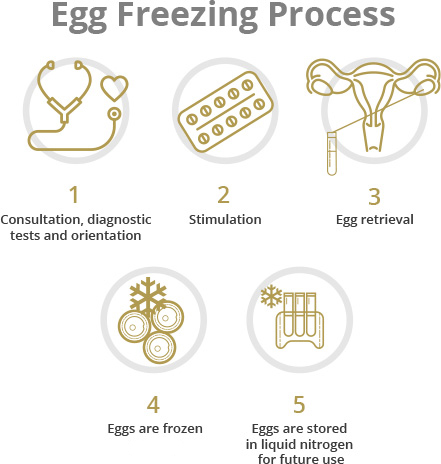
The process of egg freezing is similar to embryo freezing, as outlined above. One of our doctors removes eggs from your body after 10 to 12 days of hormone injections. The unfertilized eggs are then frozen for future use.

As with embryo freezing, egg freezing takes place approximately two weeks after the onset of your period. Depending on when your menstrual cycle occurs, this may require a two to four week delay to freeze eggs before beginning your cancer treatment.

When you are ready to use your frozen eggs, we thaw them and fertilize the surviving eggs with a procedure call intracytoplasmic sperm injection (ICSI), using your partner’s or a donor’s sperm. The resulting embryos are then transferred to your uterus.

Top

how successful is egg freezing?

The success of egg freezing is currently less than embryo freezing, as eggs are more delicate structures that do not freeze and thaw as well as embryos. Typically, we would hope to freeze 5-15 eggs in a cycle, of which 70% to 80% will likely survive the freeze-thaw process. In turn, we would expect 50% to 70% of the thawed eggs to fertilize. The success rate is approximately 20% to 30% each time an embryo created from a frozen egg is placed into your uterus.

Top

what is the cost of egg freezing?

The cost of egg freezing is similar to embryo freezing.
The cost of using your frozen eggs to get pregnant will change over time. Using frozen eggs is generally more expensive than using frozen embryos because of the added cost of ICSI for fertilization. Please see our website for our current fees.

Top

what is ovarian tissue freezing?

Ovarian tissue freezing is a highly experimental procedure that is only suitable for select women who do not have time to do embryo or egg freezing or cannot use fertility medications. The success rates of ovarian tissue freezing are too early to evaluate as this technique is very new. To date, fewer than 10 babies have been born worldwide.

As ovarian tissue freezing is new and very little information is available on this technique, women should not consider this as the only way to preserve their fertility. Women whose cancer involves their ovaries are not candidates for ovarian tissue freezing.

Top

what does ovarian tissue freezing involve?

In this process, one of our doctors removes part or all of an ovary in a surgical procedure performed under general anesthetic. Sometimes it can be done as a part of another necessary surgery. No hormone stimulation is needed. The tissue that is removed is divided into thin strips which contain immature eggs. The tissue is then frozen and stored for future use.

Top

doing what’s right for you

At Genesis we understand that embryo freezing, egg freezing, and ovarian tissue freezing may not be right for you. We want to help you find the best choice for your fertility journey and would be happy to discuss all your options. For some couples other choices like childlessness, surrogacy, use of donor eggs or embryos, or adoption might be more suitable.

Top

costs

Infertility consultations and most tests are covered by MSP.

confidentiality

All services are provided in a completely discreet and confidential environment.